
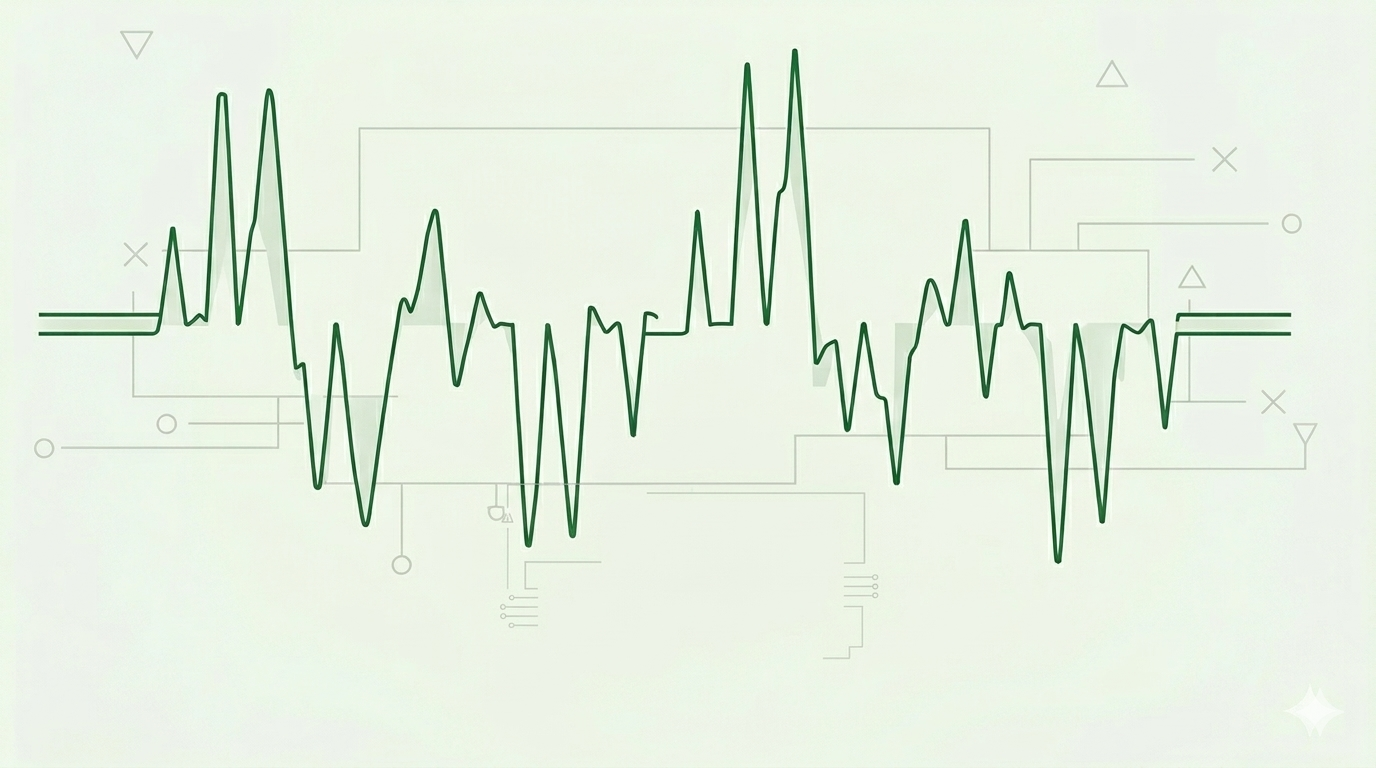
AI training clusters don't draw power like traditional servers. They surge. Synchronously. And the transformer sitting inside your PDU was probably never designed for it.
In November 2025, the Uptime Institute published research (Daniel Bizo, Electrical considerations with large AI compute) documenting what facilities engineers had been seeing on their monitoring dashboards: in rack-scale systems based on NVIDIA's GB200 NVL72 architecture, power can climb from around 60–70 kW to more than 150 kW per rack, and in the worst cases load swings can reach 150% of the system's steady-state level. Every rack in the cluster does it at the same time, because every GPU is working on the same training job.
Those power swings create two distinct problems for your transformer. The first is a capacity problem: whether the transformer can handle the total load, and the way that load arrives. The second is a power quality problem: whether it can handle the harmonic characteristics of that load. This article covers the second. For the capacity problem — including how to size transformers for correlated GPU burst loads without stranding sellable capacity — see our companion article, The AI Tenant Problem: Transformer Sizing for Colocation Halls That Weren't Built for GPUs.
That synchronized demand creates electrical conditions that standard K-13 transformers were never built to handle. And if you're deploying AI infrastructure on K-13 rated PDU transformers, you're running equipment that could fail at critical moments, with shortened lifespans.
Traditional data center loads are well-understood. A mix of servers, storage, and networking equipment draws relatively steady power with moderate harmonic content. Modern server power supplies use active power factor correction (PFC), which shapes the input current to closely track the voltage waveform — drawing near-sinusoidal current with relatively low harmonic distortion, and far less than the older diode-rectifier supplies that gave data center harmonics their reputation. At the panel and PDU level, diversity effects — different loads drawing at different times — further reduce the aggregate harmonic impact.
This is the environment K-13 transformers were designed for. Mixed loads. Natural diversity. Moderate harmonic content that averages out across phases and over time.
AI infrastructure breaks every one of those assumptions.
A rack of NVIDIA GPUs is not a mixed load. It's dozens of identical, high-power switching supplies running the same workload at the same time. When a training batch starts, they all ramp simultaneously. When a checkpoint runs, they all drop simultaneously. A joint research paper from Microsoft, OpenAI, and NVIDIA confirmed that due to the large and synchronous nature of the job, participating nodes are co-located to form a majority of a datacenter — or even multiple datacenters in the same grid — making the power swings visible at the rack, datacenter, and power grid levels.
These swings happen fast. Research from the University of Alberta found that modern AI accelerators can exhibit power variations exceeding 50% of their thermal design power (TDP) within milliseconds — abrupt, multi-ampere current surges that a transformer's protection and voltage regulation must contend with.
The problem for your PDU transformer isn't just the magnitude. It's the combination of factors:
Uptime's analysis is blunt about the consequence: these step loads force operators to reconsider their approach to both capacity planning and safety margins, because the specialized compute hardware creates large power swings and can produce frequent surges close to — or above — its hardware power rating.
NVIDIA themselves acknowledged the severity of this problem. Their GB300 NVL72 technical blog explains that thousands of GPUs operate in lockstep and perform the same computation on different data, and that this synchronization results in power fluctuations at the grid level. Their engineering response was to add roughly 65 joules of electrolytic capacitance per GPU to the GB300 to smooth power demand at the grid input level — a hardware fix to an infrastructure-level problem.
K-factor isn't a marketing label. It's a quantifiable rating defined in UL 1561 (Section 3.5) that describes how much additional harmonic-induced heating a transformer can safely handle. The formula is:
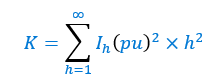
Where Ih(pu) is the rms current at harmonic h (per unit of rated rms load current) and h is the harmonic order. In plain terms, each harmonic current is squared, multiplied by its harmonic order squared, and summed across all harmonics. This captures a physical reality: because winding eddy current losses increase with the square of frequency, higher-order harmonics cause disproportionately more heating in transformer windings.
Specifically, a 5th harmonic current (300 Hz) creates 25 times the eddy current heating that the same magnitude of current would cause at the fundamental 60 Hz. The 7th harmonic creates 49 times. The 13th creates 169 times. These losses concentrate in the winding conductors, particularly at their surfaces due to skin effect and between adjacent conductors due to proximity effect. (For the underlying physics of harmonics and eddy-current heating, see our Harmonics white paper.)
A note on the "percentage of non-linear load" rule of thumb. You'll often see K-factor ratings mapped to blanket percentages of non-linear load — K-4 for about 25%, K-13 for 50–75%, K-20 for 75–100%. Treat these as loose legacy heuristics, not engineering. As the formula above makes explicit, K-factor is set by the harmonic spectrum — which harmonics are present and at what magnitude — not by the fraction of the load that happens to be non-linear. Two facilities with identical non-linear percentages can require different K-ratings if their harmonic signatures differ: a population of modern active-PFC supplies with low individual THD produces a very different spectrum than an equal share of six-pulse drives.
What actually pushes an AI facility toward K-20 is not simply that the load is "more non-linear," but that it is homogeneous and synchronized — thousands of identical switching supplies with no load diversity to cancel harmonics, presenting a concentrated, reinforcing spectrum that the transformer sees continuously.
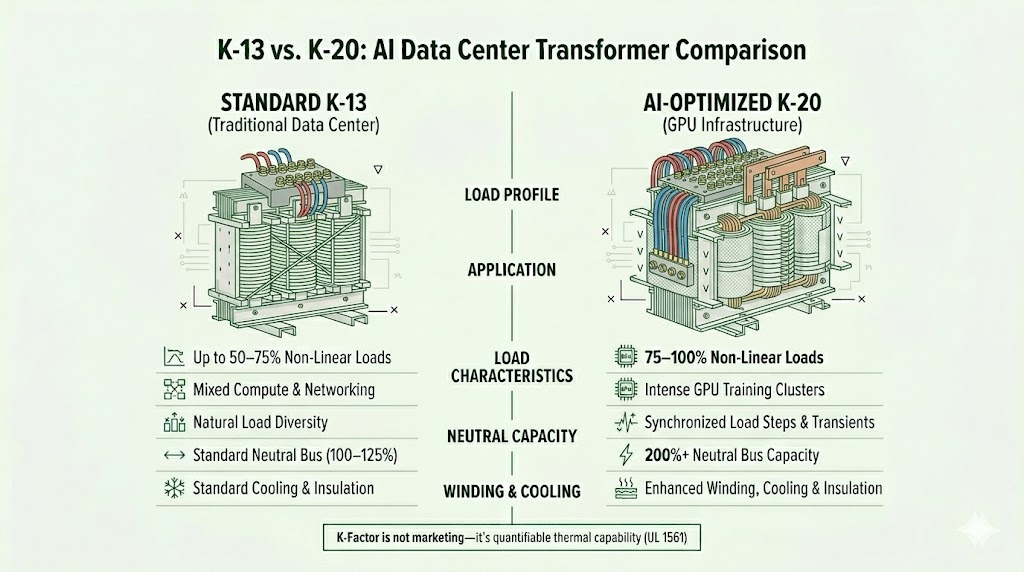
The physical differences between a K-13 and K-20 transformer are not subtle. K-20 typically requires:
A K-13 transformer has these same features — but proportioned for a load whose harmonic spectrum is moderated by diversity: varied equipment, varied duty cycles, some genuinely linear load. Strip away that diversity, as a homogeneous GPU population does, and the harmonic content concentrates and reinforces, eroding the thermal margins that made K-13 adequate for a traditional mixed hall.
Harmonic-induced overheating doesn't trip an alarm and shut things down cleanly. It degrades transformer insulation gradually — and then fails abruptly.
Transformer insulation aging follows the Arrhenius relationship: for dry-type transformers, roughly every 10 °C above the rated hot-spot temperature cuts insulation life in half. A transformer designed for 20 years of service that consistently runs 30 °C above its thermal design point won't last five. The failure mode isn't gentle — it's thermal protection tripping your PDU and taking down every rack downstream, or an insulation breakdown that requires emergency replacement.
And replacement isn't quick. Dry-type PDU transformers in the 75–500 kVA range currently run 12–30 week lead times industry-wide. Custom K-20 configurations can take longer. Add emergency premium pricing, and you're paying substantially more for a transformer you should have specified correctly the first time.
But the transformer cost is the smallest number in the equation. For a GPU-as-a-service provider operating dozens of data centers with racks drawing 120–132 kW each, a PDU failure during a training run means lost compute hours that can't be recovered, potentially restarted training jobs, and SLA penalties to customers paying premium rates for GPU time. A single NVIDIA GB200 NVL72 rack draws approximately 120 kW. An unplanned outage affecting even a few racks during a multi-week training run is an expensive lesson in transformer selection.
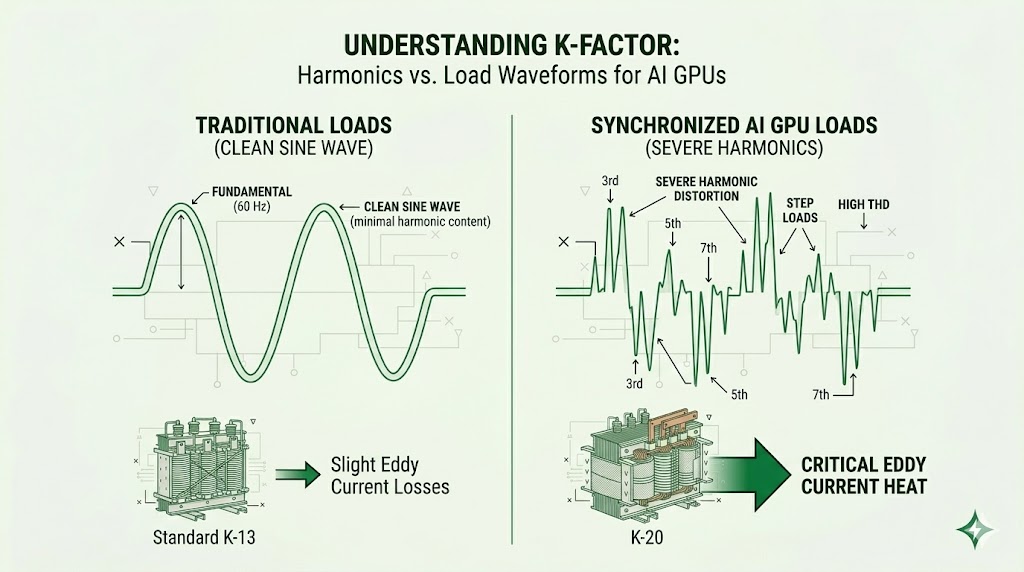
Not every data center needs K-20. Here's an honest framework — built around load character, not a single percentage.
K-13 is the right specification when:
K-20 is the right specification when:
If you're deploying NVIDIA GPU infrastructure and you're not sure what your harmonic profile will look like, specify K-20. The cost difference between K-13 and K-20 is a fraction of the replacement cost if you spec'd wrong — and in a mixed-tenant hall, "you're not sure what your harmonic profile will look like" is the permanent condition, not a temporary one.
This doesn't go away with 800 VDC. NVIDIA's move toward 800 VDC distribution eliminates the AC/DC power supply inside the rack, but it doesn't eliminate AC from the facility — it converts grid AC to 800 VDC at the perimeter using large industrial rectifiers. That front-end rectifier is itself a massive, concentrated non-linear load. The harmonic problem doesn't disappear; it moves upstream and concentrates, which makes harmonic-aware transformer design more relevant to the perimeter conversion stage, not less. For most existing halls, this is a 2027-and-beyond, greenfield consideration.
Not everyone agrees AI needs K-20. Schneider Electric, notably, does not offer a K-20 transformer at all — their low-voltage line stops at K-4 and K-13. Their published reasoning is worth taking seriously: they argue that, following ANSI/IEEE C57.110, a transformer with a nominal impedance between 3% and 5% will not see a K-factor load beyond roughly K-9, because harmonic diversity and the transformer's own reactance attenuate the harmonic content before it reaches the windings.
In a conventional mixed commercial building, they're right. That argument is sound wherever the load is genuinely diverse — which is exactly the assumption behind the "K-13 is always enough" position.
An AI cluster is the specific case where that assumption fails. The attenuation Schneider describes depends on harmonic diversity — different loads contributing different harmonics at different phase angles that partially cancel. A hall full of identical GPU switching supplies running the same workload in lockstep has no diversity to attenuate. The harmonics don't cancel; they reinforce, and they do it continuously at high utilization. The engineering rationale for capping at K-13 is valid precisely to the degree that your load looks nothing like an AI training cluster.
So the K-20 question isn't "which manufacturer is right in general" — it's "does your load have the diversity that makes K-13 sufficient?" For synchronized GPU workloads, it doesn't.
K-20 availability itself is not the differentiator it's sometimes made out to be — several manufacturers catalog it. Hammond Power Solutions lists K-4, K-9, and K-13 as standard on their Sentinel K line with K-20 available as a configured option, and Eaton catalogs K-4 through K-20 (and even K-30) as a standard family. So don't shop on the K-number alone. For AI and mixed-tenant colocation loads specifically, the specification that matters is the combination:
Quality Transformer & Electronics manufactures K-20 dry-type transformers across the 75–500 kVA PDU range — with 80 °C and 115 °C temperature rise available as standard options, not special orders — and typical lead times of 4–6 weeks from facilities in the Bay Area, Greater Los Angeles, and Nevada.
Quality Transformer & Electronics — UL 1561 Listed | DOE 2016 Compliant | ISO 9001:2015 | Made in California
Do AI data centers need K-20 transformers instead of K-13? For synchronized GPU training loads, yes. A hall of identical GPU switching supplies running the same workload in lockstep has no load diversity to cancel harmonics, so the harmonic content concentrates and reinforces continuously — the condition K-20 is built for. K-13 remains appropriate where the load is genuinely mixed and diverse; the deciding factor is the harmonic spectrum, not simply whether the equipment is labeled "AI."
What is the difference between a K-13 and a K-20 transformer? Both are engineered to handle harmonic heating from non-linear loads, but K-20 is rated for a more severe harmonic spectrum. Compared with K-13, a K-20 unit typically has greater conductor cross-section, an oversized neutral (commonly 200%), a delta-wye configuration to trap triplen harmonics, and enhanced cooling. K-factor itself is defined in UL 1561 as the sum of each harmonic current squared multiplied by its harmonic order squared.
Is a transformer's K-factor determined by the percentage of non-linear load? No. K-factor is set by the harmonic current spectrum — which harmonics are present and at what magnitude — not by the fraction of load that is non-linear. Two facilities with identical non-linear percentages can require different K-ratings if their harmonic signatures differ; a population of modern active-PFC supplies produces a very different spectrum than an equal share of six-pulse drives. Common rules of thumb like "K-13 equals 50–75% non-linear load" are legacy heuristics, not calculations.
Why does Schneider Electric offer only K-13 and not K-20? Schneider's stated position is that, following ANSI/IEEE C57.110, a transformer with 3–5% impedance will not see a K-factor load beyond about K-9, because harmonic diversity and the transformer's own reactance attenuate the harmonics. That reasoning holds for conventional mixed commercial buildings. It breaks down for AI clusters specifically, because a homogeneous, synchronized GPU load has no diversity to provide that attenuation.
Does an 800 VDC data center architecture make K-rated transformers unnecessary? No. NVIDIA's 800 VDC architecture removes the AC/DC power supply from inside the rack, but it converts grid AC to 800 VDC at the facility perimeter using large rectifiers, which are themselves concentrated non-linear loads. The harmonic problem moves upstream and concentrates rather than disappearing. For existing halls this is largely a 2027-and-later, greenfield consideration.
Which manufacturers make K-20 transformers? Several do; K-20 availability is not rare. Hammond Power Solutions lists K-4, K-9, and K-13 as standard with K-20 available as a configured option, and Eaton catalogs K-4 through K-20 (and K-30) as a standard family, while Schneider offers only up to K-13. The more important specification for AI loads is the combination of K-20 with a low temperature rise, low impedance, and an oversized neutral.


