

A tenant signs for four cabinets. They're bringing GPUs — call it 40 kW a cabinet, maybe more. The hall was underwritten in 2019 at 8 kW average across a diverse enterprise base: storage, virtualization, a few network racks.
Your sales team is thrilled. Your facilities engineer is doing arithmetic and not saying much.
The question isn't whether you can feed the tenant. It's what that tenant does to the shared infrastructure between them and the utility — and how much of the rest of the hall you just stranded to serve them.
This is a different problem from the one hyperscalers have, and most of the AI infrastructure content written in the last eighteen months is aimed at hyperscalers. Their answer is "build a purpose-built AI factory and oversize everything." You can't oversize. Oversizing is how you lose money.
The distinction matters because it inverts the engineering conclusion.
Hyperscalers don't put training clusters in your building. They handle the majority of AI training on owned infrastructure and use colocation for network exchange points and edge deployments. The primary buyers of high-density AI colocation are mid-market enterprises, AI inference startups, and companies building private models.
That means the load you're absorbing is not the 10,000-GPU synchronous training cluster that the industry's alarming research papers describe. It's a 4-to-40 cabinet deployment — enough to break a shared PDU, not enough to move a grid.
But the Uptime Institute has identified precisely who is at risk, and it's you. Their December 2025 analysis notes that operators running AI on general-purpose infrastructure face the greatest exposure: many such environments lack the workload diversity to absorb power swings or the specialized engineering to manage dynamic power behavior, leaving them exposed to failure events, hardware damage, shortened component lifespans, and reduced UPS reliability. And this is not a fringe case — nearly three in ten operators already perform AI training, and of those that don't, nearly half expect to begin.
The hyperscaler builds a hall where every rack is a GPU rack, homogeneous by design. You have a GPU tenant in cabinet 14 and an enterprise storage tenant in cabinet 15, sharing a transformer. That is a harder power quality problem, not an easier one — and nobody is writing about it.
Here is the constraint every colo operator is under, and it is the reason hyperscale advice is actively wrong for you:
Power, not floor space, is now the binding constraint in every major U.S. market. Per CBRE's North America Data Center Trends H2 2025, primary-market vacancy fell to a record low of roughly 1.4%, and the average asking rate for a 250-to-500 kW requirement rose 6.6% year-over-year to a record $196.25 per kW/month — with the large majority of capacity under construction preleased before a cabinet is installed.
Read that last number as an engineer, not a marketer.
Every kVA of transformer headroom you buy and cannot sell is stranded revenue at roughly $196/kW/month. Schneider Electric's colocation guidance makes the point directly: the vast majority of colocation data centers were designed for close to 4 kW per rack, and increasing average rack density is how you recover stranded PDU capacity — stranded capacity being what happens when a facility hits its power limit while floor space sits empty.
So when a hyperscale-oriented article tells you to apply a 4x nameplate multiplier and "size for peak" — understand what it is asking you to do. It is asking you to buy transformer capacity you will never bill for, in a market where capacity is the product.
Your objective is not maximum headroom. It is maximum sellable capacity with adequate transient margin. Those are different specifications, and the difference is worth real money.
Most colo capacity planning starts by summing tenant nameplate. That number is a ceiling, not a demand, and treating it as demand is how halls end up half-empty on paper and fully "sold."
Researchers at Brookhaven National Laboratory instrumented an 8-GPU NVIDIA H100 HGX node and measured actual draw during real training. Training Llama2-13b, they recorded a median node draw of 7.92 kW and a maximum of 8.42 kW — against a 10.2 kW manufacturer rating. Peak measured draw came in roughly 18% below nameplate, with GPU utilization near maximum on all eight chips.
For a colo operator this is directly monetizable: a GPU tenant's nameplate overstates their sustained draw. Sizing your shared infrastructure by naively stacking tenant nameplates — then derating, then adding growth margin — compounds three layers of conservatism on top of a base figure that measurement says is already padded. That is capacity you bought, can't bill, and can't sell to anyone else.
Meter your tenants. Commissioning data beats nameplate arithmetic, and in a market at $196/kW/month the delta is a line item, not a rounding error.
But — and this is the whole article — the sustained draw is not what breaks your transformer.
AI loads are correlated. The mechanism is documented in a joint paper from 57 authors at Microsoft, OpenAI, and NVIDIA: because training jobs are synchronous, each iteration alternates between a compute-heavy phase (every GPU working on local data) and a communication-heavy phase (all GPUs synchronizing). Compute phases draw far more power, so large power swings occur, with amplitude scaling with cluster size.
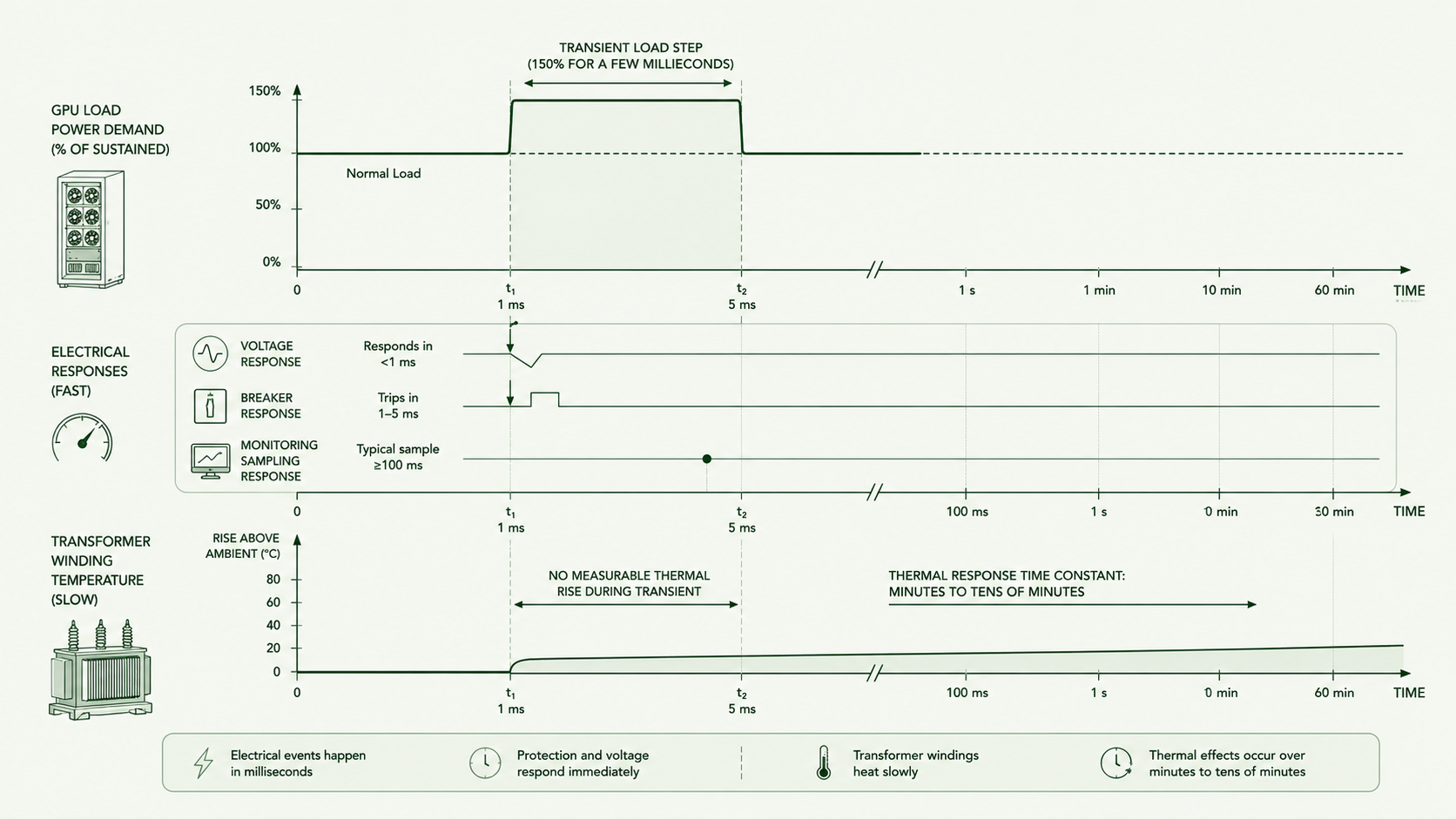
The transitions are fast. Researchers at the University of Alberta found modern AI accelerators can exhibit power variations exceeding 50% of thermal design power within milliseconds.
The Uptime Institute reports that under synchronized conditions, AI clusters can sometimes reach 150% of their steady-state maximum power levels.
Now: that 150% figure is the most misused number in this entire subject area, and understanding it correctly is what separates a competent colo spec from a wasteful one.
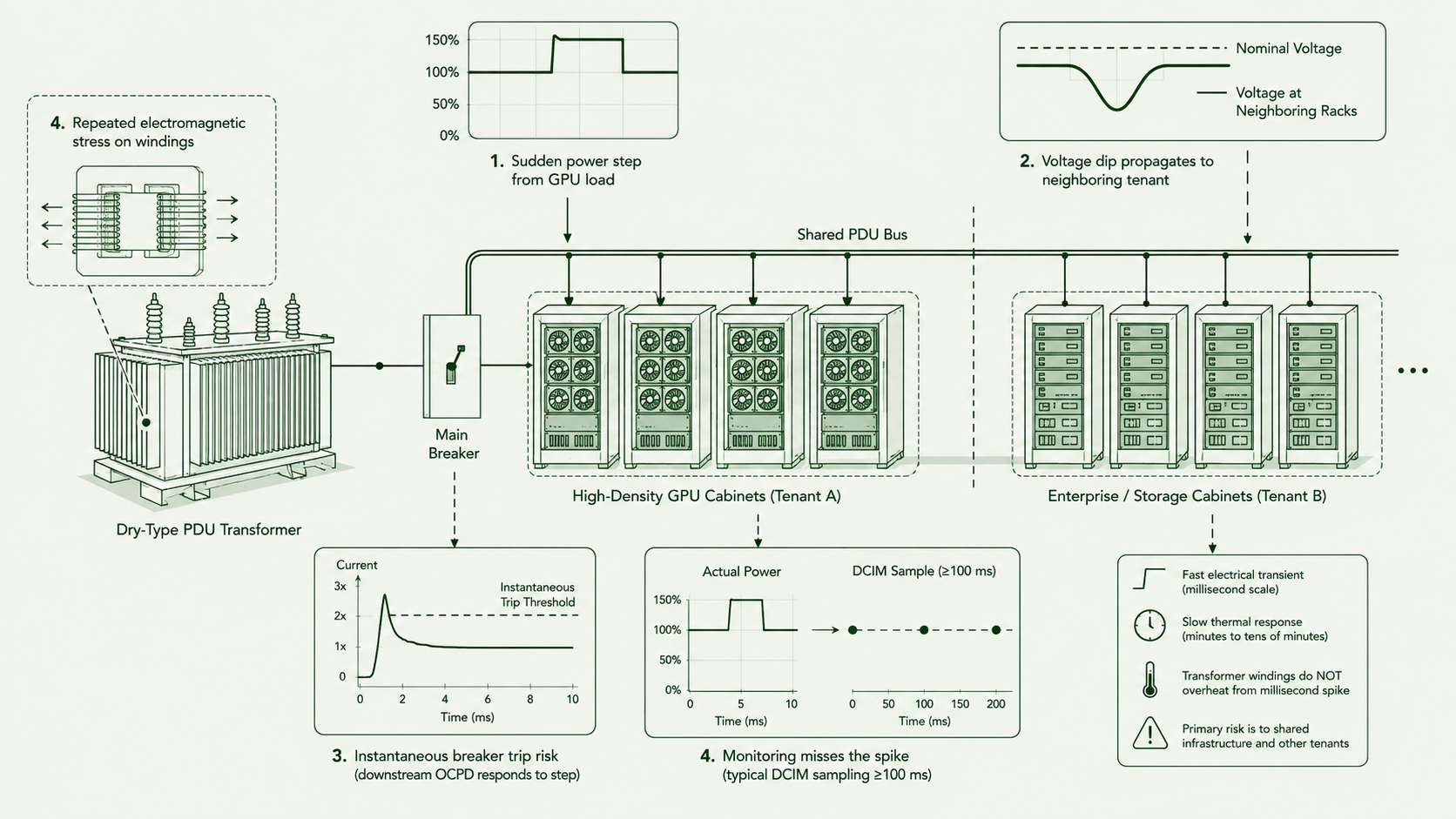
Uptime's Douglas Donnellan is describing millisecond-scale transients exceeding the rated capacity of row-level UPS modules — devices with essentially zero thermal mass, sized under legacy capacity allocation practices. He is not describing a sustained 150% thermal load on a distribution transformer. The distinction is not academic:
A dry-type transformer has a thermal time constant measured in minutes to tens of minutes. A 150% excursion lasting five milliseconds produces no measurable winding temperature rise. Transformers are simply not thermally responsive at that timescale — which is precisely why IEEE C57.96 permits short-term loading above nameplate at all.
Any vendor telling you a millisecond GPU spike will cook your transformer windings is selling you kVA you don't need — and, at $196/kW/month, kVA you can't afford to strand.
What a repeated, high-di/dt step load actually threatens in your shared PDU is real, and it is not thermal:
The fix is a low-impedance design with real thermal reserve — not a bigger box. That distinction is the difference between a transformer that holds up and a hall you can't fill.
Hyperscale AI halls are harmonically homogeneous: 100% GPU, one known spectrum, engineer once. Your hall is not.
A colo PDU transformer serves a load whose harmonic spectrum:
This is why specifying K-factor from the "percentage of non-linear load" — the rule of thumb most vendors quote — is wrong for colo, and dangerous. K-factor is a function of the harmonic current spectrum, Σ(Ih² × h²) per UL 1561 — not of what fraction of your load is non-linear. Two halls with identical non-linear percentages can have K-factors that differ by a factor of two, depending on what the tenants actually plugged in.
For a mixed-tenant hall with an unknown and drifting spectrum, spec K-rating for the worst case you're willing to sell into — then contract around it. (See our Harmonics white paper for the underlying physics, and Why Your AI Data Center Needs K-20 Transformers for the harmonics half of this specification.)
Consider making harmonic profile a term in the tenant agreement. Colo operators already write Acceptable Use Policies around power density and cooling. Almost none address current distortion — and the tenant whose rectifier front end pollutes your shared neutral is imposing a cost on every other tenant on that transformer.
This is the highest-leverage line item on a colo transformer spec, and it is almost always left at the default.
Dry-type transformers are built in three standard average winding rises, paired with insulation systems per IEEE C57.96:
Temperature rise vs. thermal reserve — all on a 220 °C insulation system. Lower winding rise buys continuous overload headroom without adding kVA.
Letter classes denote the insulation material's thermal rating: Class B = 130 °C, F = 155 °C, H = 180 °C, R/N = 220 °C. A 150 °C rise on a 220 °C system reaches a 220 °C hot-spot at full load in a 40 °C ambient — zero reserve.
Most standard dry-type transformers ship at 150 °C rise. It uses the least conductor and it's the cheapest to build. It also has no thermal reserve at nameplate whatsoever.
Here is the colo argument, and it is a revenue argument:
An 80 °C-rise transformer at 300 kVA carries roughly 47% continuous overload capability — real burst headroom for your GPU tenant — without buying 150 kVA you can't bill for.
A 150 °C-rise transformer at 450 kVA gives you nominally the same margin, costs more, takes more floor, and strands 150 kVA at ~$196/kW/month.
Same protection. One of them is roughly $29,000 a month of capacity you're holding in reserve instead of selling.
Lower rise also runs cooler in steady state, which compounds: insulation aging follows the Arrhenius relationship, where roughly every 10 °C above rated hot-spot halves insulation life. Your transformer is a 15–20 year asset in a building where the tenants turn over every 3.
Buy thermal reserve. Don't buy nameplate.
A 2019 hall, 40 cabinets on a 300 kVA PDU transformer, underwritten at 8 kW/cabinet diverse enterprise load. A tenant wants 4 cabinets at 40 kW.
Step 1 — Real load, not stacked nameplate.
Step 2 — Convert to apparent power. Transformers are rated in kVA, not kW. Modern GPU PSUs use active PFC; assume 0.96 displacement PF. 325 kW ÷ 0.96 ≈ ~339 kVA. (Run your own numbers with our kVA Calculator.)
Step 3 — The 300 kVA unit is already undersized on fundamentals. This is a genuine capacity problem, not a transient one. It has to be replaced regardless.
Step 4 — Size the replacement.
The multiplier that falls out is roughly 1.5x — not the 3-4x the hyperscale literature quotes. Because your growth headroom isn't dead margin. It's inventory.
You'll have seen NVIDIA's announcements about moving data centers to 800 VDC and "designing AC out." Two things worth knowing:
First, they're not eliminating AC from the facility — they're eliminating the AC/DC power supply from inside the rack. NVIDIA's own architecture converts 13.8 kV AC grid power to 800 VDC at the data center perimeter using industrial-grade rectifiers. AC still enters the building. The conversion boundary moves upstream. A transformer stage is still required — whether a conventional transformer-rectifier unit or a solid-state transformer.
Second, and more relevant to you: this is a 2027 greenfield story. Full-scale production of 800 VDC data centers coincides with NVIDIA's Kyber rack systems in 2027, and NVIDIA describes it as a gradual evolution that "supports all existing data centers while providing a smooth path" forward. Every GB200 and GB300 rack shipping today is AC-fed with in-rack PSUs, and so is the VR200 generation.
No colo operator is ripping out LVAC distribution in an existing hall to install 800 VDC busway for one tenant. The transformer you specify for a retrofit today will be serving AC-fed racks for its entire service life. Plan accordingly — and note that when 800 VDC does arrive at scale, it arrives as a massive concentrated non-linear rectifier load, which makes harmonic mitigation more important, not less.
Quality Transformer & Electronics (QT&E) manufactures dry-type transformers — K-rated, Phase-Shift, custom and catalog — as a standard product across the 75–500 kVA PDU range, from facilities in the Bay Area, Greater Los Angeles, and Nevada, with typical lead times of 4–6 weeks. Founded in 1968, QT&E has built its reputation on tested engineering rather than off-the-shelf substitutes. For colocation operators retrofitting existing halls under signed AI tenant leases, that means a transformer spec built around your real load and step characteristics — 80 °C or 115 °C rise, correct K-rating for a mixed-tenant spectrum, low impedance for the transients that actually matter — delivered on a schedule that matches your tenant's move-in date, not a 12–30 week industry-standard wait.
Quality Transformer & Electronics — UL 1561 Listed | DOE 2016 Compliant | ISO 9001:2015 | Made in California
How should a colocation operator size a transformer for a GPU or AI tenant? Size from measured load, not stacked nameplate, and take your headroom in temperature-rise class rather than oversized kVA. Convert the real load to kVA at a stated power factor (around 0.96 for active-PFC GPU supplies), apply a growth factor once, and coordinate protection against the transient step load. For a typical colocation retrofit this yields roughly a 1.5× multiplier over the IT load — not the 3–4× that hyperscale-oriented guidance often quotes.
Will a millisecond GPU power spike overheat my transformer? No. A dry-type transformer's thermal time constant is measured in minutes to tens of minutes, so a 150% excursion lasting a few milliseconds produces no measurable winding temperature rise. What a fast step load actually threatens is different: secondary voltage sag, an instantaneous breaker trip, and mechanical winding stress. Sizing extra kVA to fight a "thermal" spike that isn't thermal is wasted capacity.
Should I oversize my transformer to handle AI workloads? Generally no — for a colocation operator, oversizing strands revenue. With wholesale power priced around $196/kW/month (CBRE, H2 2025), every kVA of headroom you buy but cannot sell is lost income. The better approach is to size for real load and buy burst margin through a lower temperature rise, which adds thermal reserve without adding unsellable nameplate.
What temperature rise should an AI or colocation transformer use? An 80 °C or 115 °C rise on a 220 °C insulation system, rather than the standard 150 °C rise. A standard 150 °C-rise unit has essentially no thermal reserve at full load, whereas an 80 °C-rise unit on the same insulation system carries roughly 47% continuous overload capability — burst headroom for GPU step loads without buying extra kVA. Insulation class and temperature rise are specified independently of the K-rating.
What is stranded capacity in a colocation data center? Stranded capacity is power or distribution capacity that cannot be sold because the facility has hit a power or infrastructure limit while floor space remains empty. In an AI-era colocation market where power is the binding constraint, oversized or poorly allocated transformer capacity is a direct form of stranded revenue. Right-sizing distribution and increasing sellable rack density are how operators recover it.
Does the shift to 800 VDC affect colocation retrofits today? Not materially yet. NVIDIA's 800 VDC architecture arrives with Kyber-class systems around 2027 and is designed as a gradual, greenfield-first evolution; every GB200 and GB300-class rack shipping today is AC-fed. A colocation operator retrofitting an existing hall will specify AC distribution transformers that serve the tenant for the equipment's full service life.
Do colocation halls need K-20 transformers for AI tenants? Often yes — but for a reason specific to colocation: you cannot predict or control the tenant's harmonic spectrum, and it changes whenever they change hardware or workload. Unlike a single-tenant AI hall you can characterize once, a mixed-tenant transformer serves a spectrum you do not govern, which argues for specifying the K-rating to the worst case you are willing to sell into. See Why Your AI Data Center Needs K-20 Transformers.


