
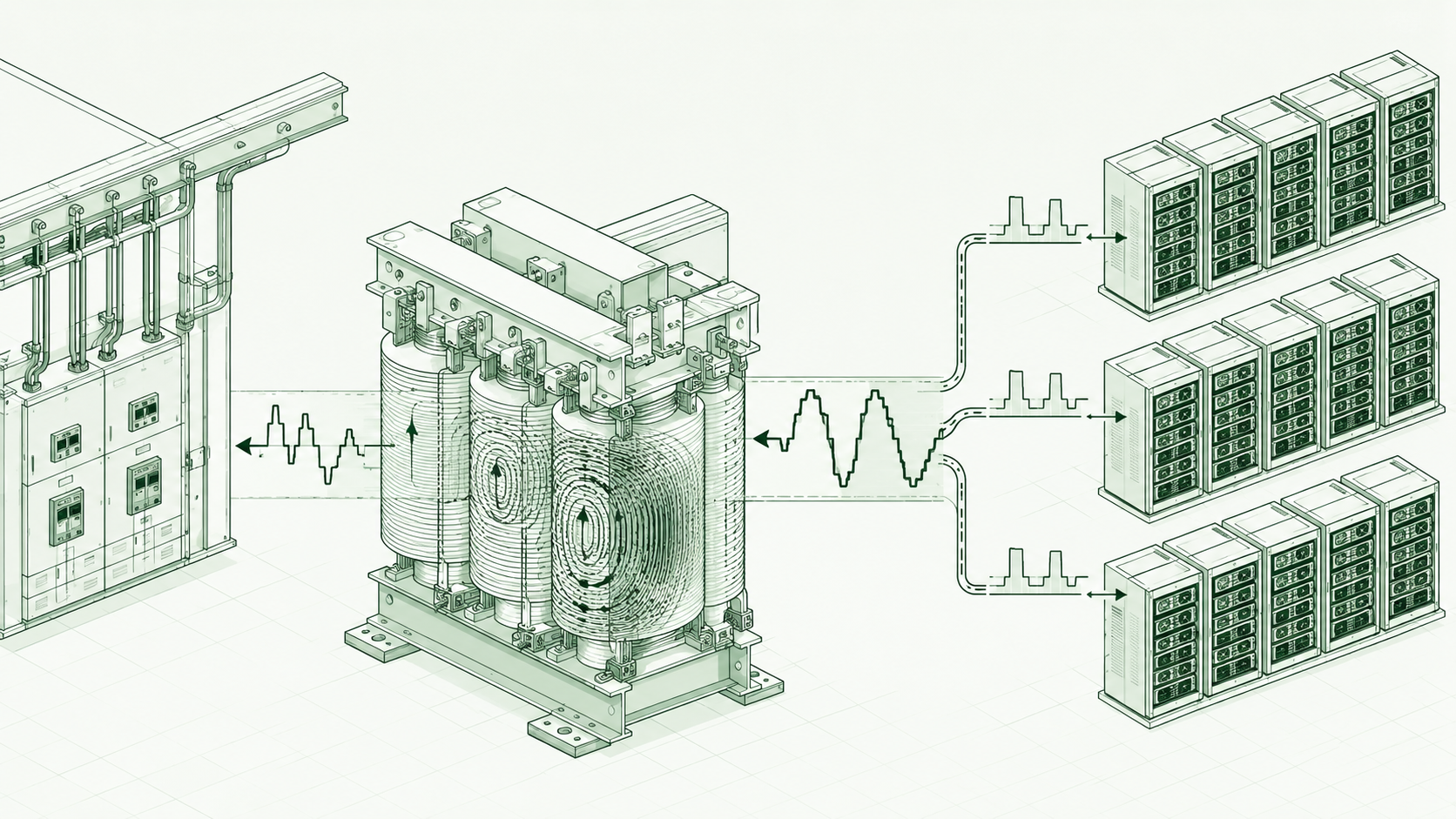
Every switching power supply in your data center draws current in pulses, not smooth sine waves — creating harmonic distortion that ripples upstream through your entire electrical distribution system. For two decades this was a manageable nuisance: K-13 rated transformers handled it, and engineers moved on to more pressing problems.
Then AI showed up, and "manageable nuisance" became "transformer killer."
Much of the published guidance on harmonic mitigation in data centers dates to the early 2010s — solid work, but written when 10–15 kW per rack was "high density" and nobody had heard of a GB200. This article updates that guidance for a world where a single rack can draw 120 kW and every GPU in the cluster surges simultaneously.
The short version: there are three ways to deal with harmonics — tolerate them (K-rated transformers), cancel them (harmonic mitigating transformers), or clean them electronically (active filters). For most AI facilities, K-20 transformers are the right first line of defense. This article explains why, and when the other two approaches earn their place.
AC power should be a clean 60 Hz sine wave. Non-linear loads — switching power supplies, variable frequency drives, UPS rectifiers — chop that wave, creating frequency multiples called harmonics: 180 Hz (3rd harmonic), 300 Hz (5th), 420 Hz (7th), and so on up the spectrum.
These harmonics cause additional heating in transformer windings and core through two mechanisms: eddy currents (circulating currents induced in conductors by the alternating magnetic field) and skin effect (current crowding toward the surface of conductors at higher frequencies). The relationship is not linear — eddy current losses increase with the square of harmonic frequency. The 5th harmonic at 300 Hz causes roughly 25 times the eddy current loss of the 60 Hz fundamental; the 13th harmonic, about 169 times.
Total Harmonic Distortion (THD) is the single number that captures severity: the harmonic content of a current (or voltage) waveform expressed as a percentage of the fundamental. IEEE 519 (most recently revised in 2022) sets a voltage THD limit of 8% at the point of common coupling (PCC) for systems at or below 1.0 kV, with stricter limits at higher voltages. Most data centers meet this standard at the PCC — but individual transformer loading inside the facility can be significantly worse, and that's where the damage happens.
Understanding this behavior is foundational to transformer specification. It's why QT&E designs K-20 rated transformers with enhanced winding geometry and cooling paths specifically for the eddy-current losses that harmonic-rich data center environments produce. For the full physics, see our Harmonics white paper.
The electrical profile of a data center changed fundamentally over the last decade, and the harmonic mitigation conversation hasn't kept pace. AI data center power quality challenges go beyond what traditional mitigation approaches were designed to address.
A conventional data center floor is a mix of servers, storage arrays, networking switches, and cooling equipment. Some loads are linear, some non-linear. They cycle independently — different workloads, different duty cycles, different power draw profiles. The aggregate THD at any given PDU transformer was typically moderate, and modern server power supplies equipped with active power factor correction (PFC) draw relatively clean current at the branch circuit. K-13 transformers handled this comfortably — they were designed for exactly this kind of mixed, moderate harmonic environment.
A rack of NVIDIA GPUs is a rack of identical non-linear loads. When a training job launches, they all draw simultaneously. When a checkpoint runs, they all drop simultaneously. The Uptime Institute documented that power use of compute nodes in AI training clusters moves in near unison, with sudden climbs from around 60–70 kW to more than 150 kW per rack for NVIDIA GB200 NVL72 systems — step changes that can produce significant harmonics and sub-synchronous oscillations that distort the sinusoidal waveform.
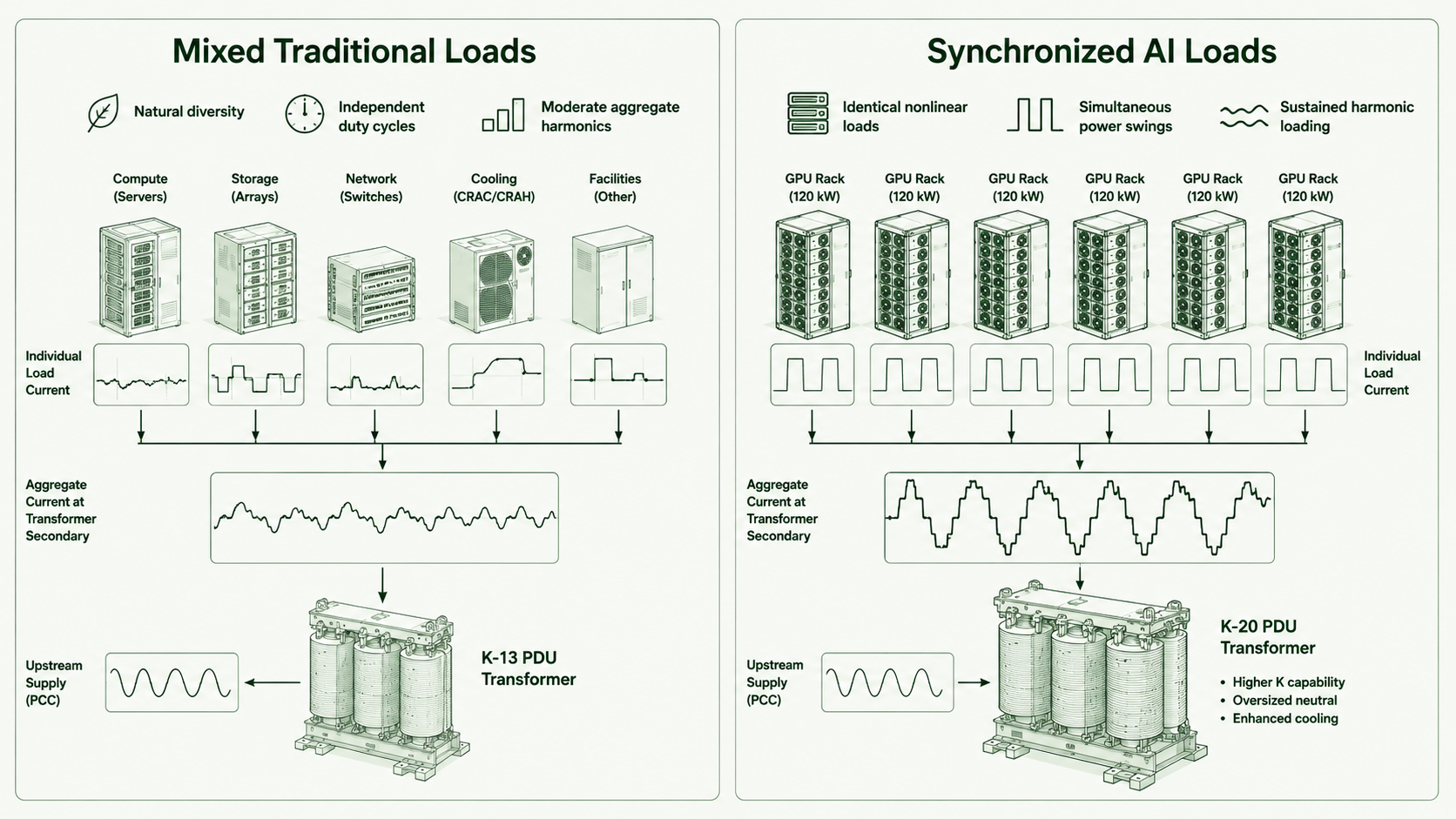
This isn't theoretical. A joint paper from Microsoft, OpenAI, and NVIDIA (August 2025) confirmed that synchronized power swings during AI training are visible at both the datacenter and grid level, reaching tens or even hundreds of megawatts in magnitude. NVIDIA themselves acknowledged the problem in their GB300 NVL72 technical blog: thousands of GPUs operating in lockstep on the same computation produce power fluctuations at the grid level.
This synchronized, sustained loading is the operating reality that QT&E's K-20 transformer specifications address — built for concentrated non-linear loads with no diversity cushion.
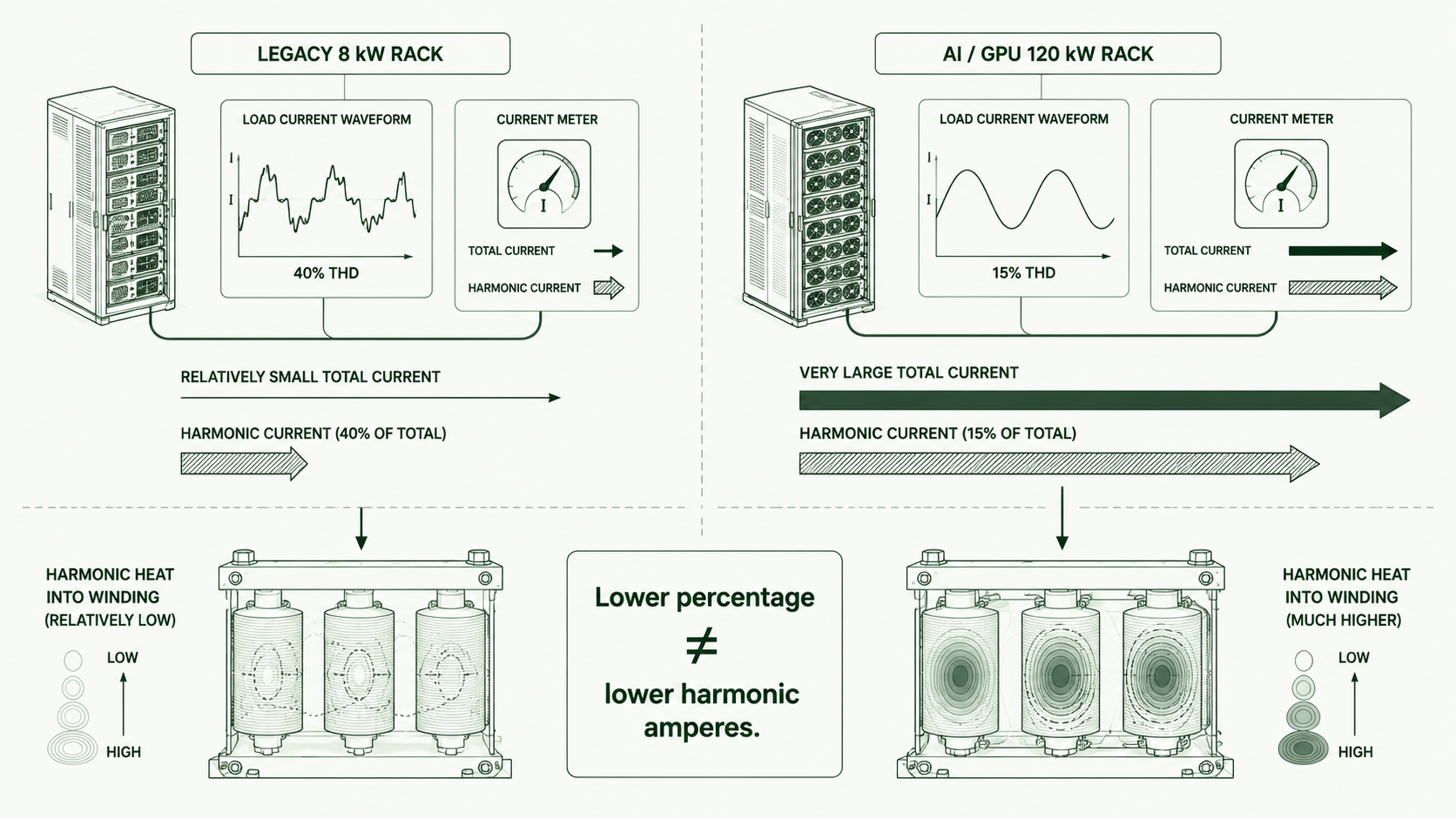
GPU power supplies are aggressive non-linear loads with high-frequency switching. Here's the subtlety worth getting right: individually, modern PFC-equipped supplies produce cleaner current than legacy switching supplies — often under 20% THD. But at the power densities AI clusters demand, even that modest percentage translates to enormous absolute harmonic current, because the fundamental current is so large. A GB200 rack at 120 kW running 15% THD injects far more absolute harmonic current than a legacy 8 kW rack at 40% THD. The percentage went down; the amperes the transformer must carry as heat went way up. And the h-squared relationship makes the higher orders punishing: the 17th harmonic causes 289 times the eddy-current loss of the fundamental. Research from the University of Alberta documented that modern AI accelerators can exhibit power variations exceeding 50% of their thermal design power within milliseconds.
Traditional data centers have daily patterns — higher utilization during business hours, lower overnight and on weekends. Transformers get thermal recovery periods. AI training runs last days or weeks at near-maximum utilization. There is no overnight dip, no weekend reduction. The transformer sees peak harmonic loading continuously, not in duty cycles. This sustained thermal stress is fundamentally different from the intermittent loading K-13 transformers were designed around.
For a deeper analysis of why these GPU power characteristics demand a different transformer specification, see our companion article: Why Your AI Data Center Needs K-20 Transformers (Not K-13).
There are three fundamental strategies for dealing with harmonics in an AI-era data center. Each has a place, and understanding when to use which is the practical question engineers need answered.
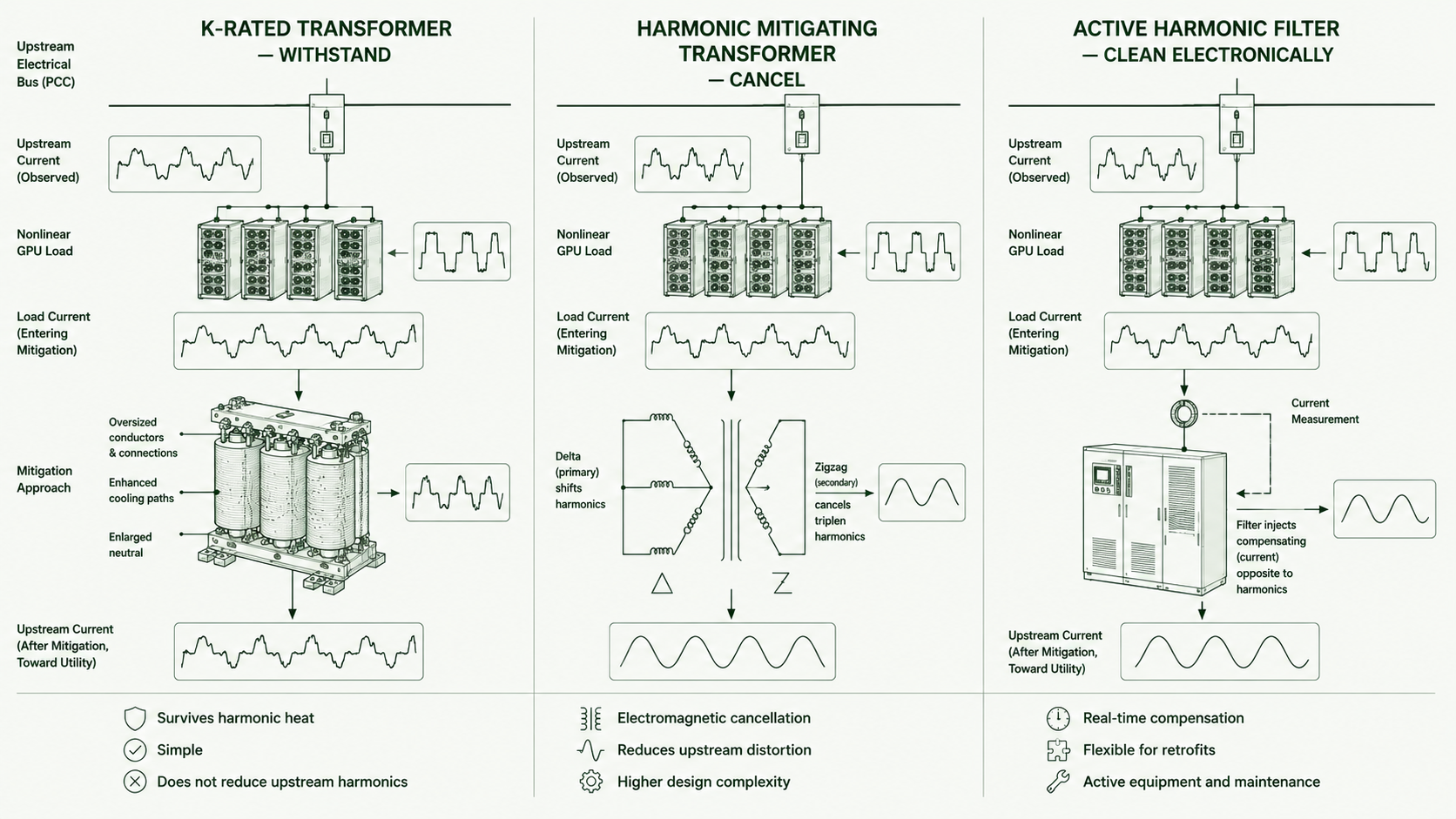
K-rated transformers don't reduce harmonics. They survive them. Built with extra thermal capacity, oversized conductors, an oversized neutral (commonly 200% of the phase conductor), and enhanced cooling, K-rated transformers are designed to handle the additional heat harmonic currents generate without degrading prematurely.
K-13 is the standard specification for conventional data center PDU applications — environments with mixed compute workloads and natural load diversity.
K-20 is built for the concentrated, synchronized, sustained non-linear loading of GPU-dense AI facilities. QT&E manufactures K-20 rated transformers as a standard product across the 75–500 kVA PDU range, with a 200% neutral, copper windings for thermal stability under sustained harmonic loading, delta-wye configuration, and high-temperature insulation. We cover the engineering specifics — and the cost of getting the K-factor wrong — in Why Your AI Data Center Needs K-20 Transformers (Not K-13).
A note on capacity: K-rating addresses harmonic quality — but your transformer also needs enough raw capacity for AI loads, and the two are separate specifications. For the sizing math, planning factors, and transient behavior specific to GPU-dense facilities, see The AI Tenant Problem: Transformer Sizing for Colocation Halls That Weren't Built for GPUs.
HMTs use phase-shifting winding configurations — typically delta-zigzag arrangements — to cancel specific harmonic orders through electromagnetic cancellation. The zigzag secondary traps triplen harmonics (3rd, 9th, 15th) magnetically within the transformer; when paired HMTs with a 30° phase shift feed a common bus, they cancel the 5th, 7th, 17th, and 19th harmonics — the dominant troublemakers in three-phase non-linear environments.
Active harmonic filters are power-electronics devices that measure the harmonic content of the load current in real time and inject counter-harmonics to cancel the distortion. They are the most flexible option, with corresponding trade-offs.
What Harmonics Actually Do to a Transformer — The Manufacturer's View
This is the section product datasheets don't cover. We build these transformers — and occasionally we see what comes back from the field when they've been asked to do a job they weren't designed for.
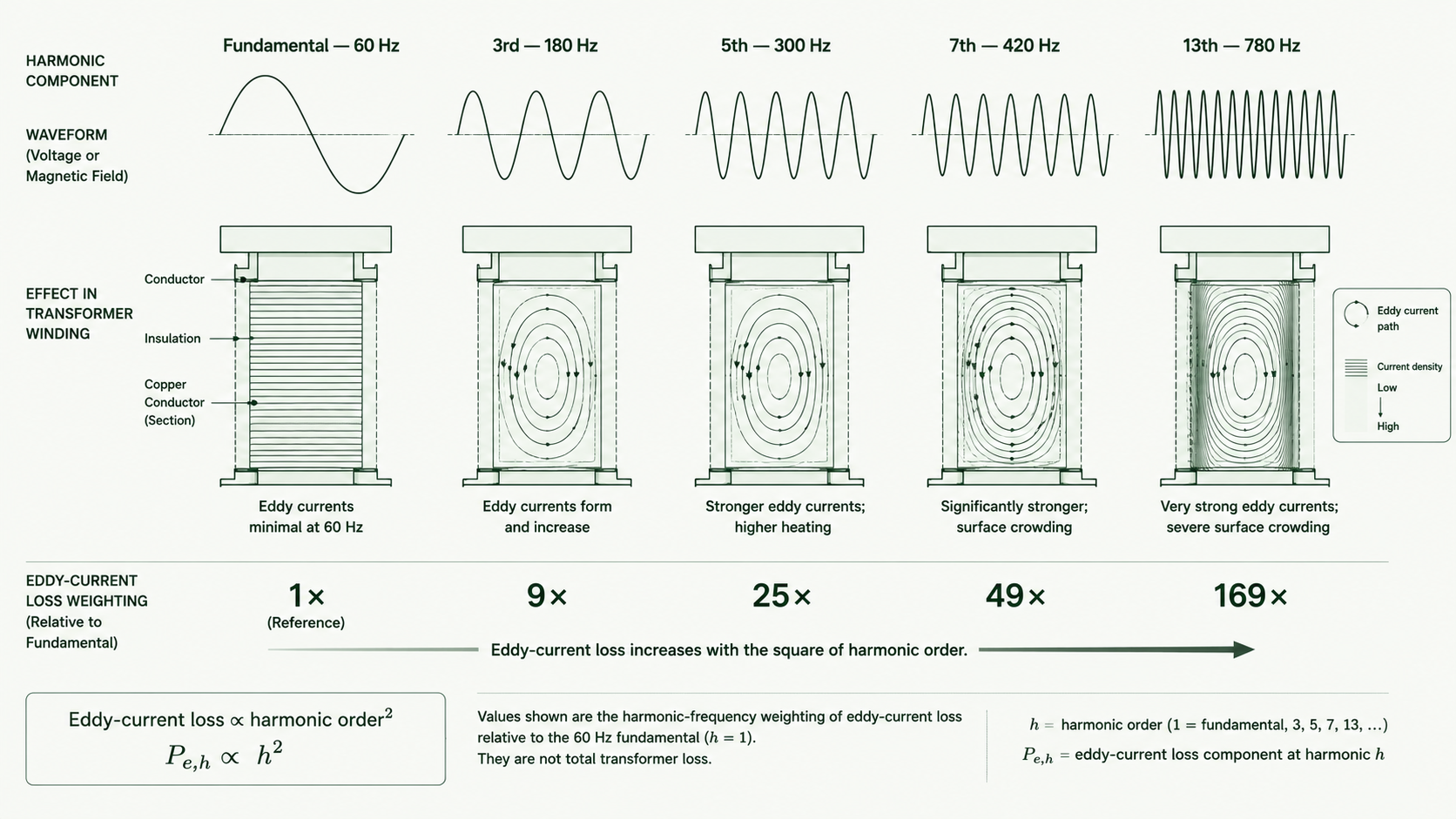
Eddy-current losses in transformer windings increase with the square of the harmonic frequency. This is not a subtle effect:
This heat concentrates in winding conductors — at the surface due to skin effect, and between adjacent conductors due to proximity effect. In a K-13 transformer pushed by sustained, high-harmonic AI loading, these losses can drive winding hot-spot temperatures well above design limits.
QT&E engineers K-20 winding designs with increased conductor cross-section and enhanced cooling channels to dissipate these harmonic-induced losses without exceeding rated hot-spot temperature — even under sustained AI training loads.
Transformer insulation life follows the Arrhenius relationship described in IEEE C57.96 (Guide for Loading Dry-Type Distribution and Power Transformers): as a rule of thumb for dry-type transformers, every ~10 °C above the rated hot-spot temperature halves insulation life. Even using that conservative 2× factor, the math is stark:
This is not a gradual degradation you can monitor and manage. Insulation failure in a dry-type transformer is often sudden. You don't get a warning — you get a shutdown, and every rack downstream goes with it.
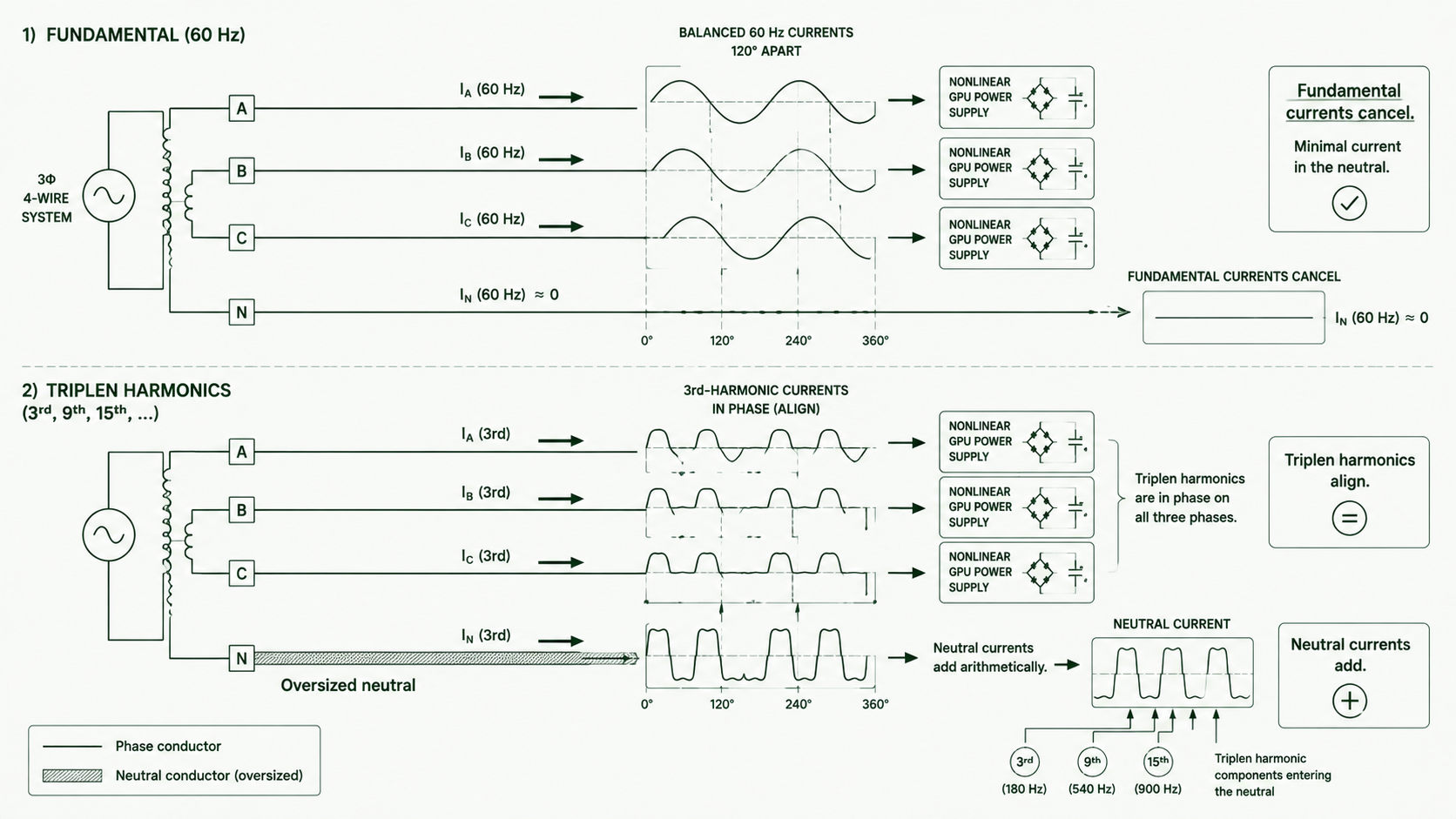
In a three-phase system, triplen harmonics (3rd, 9th, 15th) are zero-sequence currents that add arithmetically on the neutral rather than canceling. Under heavy non-linear loading, neutral current can approach or exceed phase current — levels QT&E has measured in the field. This is why K-rated transformers are built with an oversized (commonly 200%) neutral, and why a standard transformer with a conventional neutral is at particular risk in GPU-dense environments where non-linear loading approaches 100%.
And when one of these transformers fails, the replacement clock is unforgiving. Standard dry-type PDU transformers commonly run 12–30 week lead times industry-wide, with custom builds longer. QT&E delivers K-20 units in 4–6 weeks. For a GPU-as-a-service provider, every day of downtime is lost revenue on training contracts that can't be paused — a point we develop in the K-20 article.
Use the K-factor definition from UL 1561 (the harmonic-loss weighting also described in IEEE C57.110):
K = Σ (Iₕ² × h²)
Where h is the harmonic order and Iₕ is the per-unit RMS current at that harmonic. If the calculated K-factor exceeds 13, the positions in question need K-20 rated transformers. (Run your load numbers with our kVA Calculator while you're at it.)
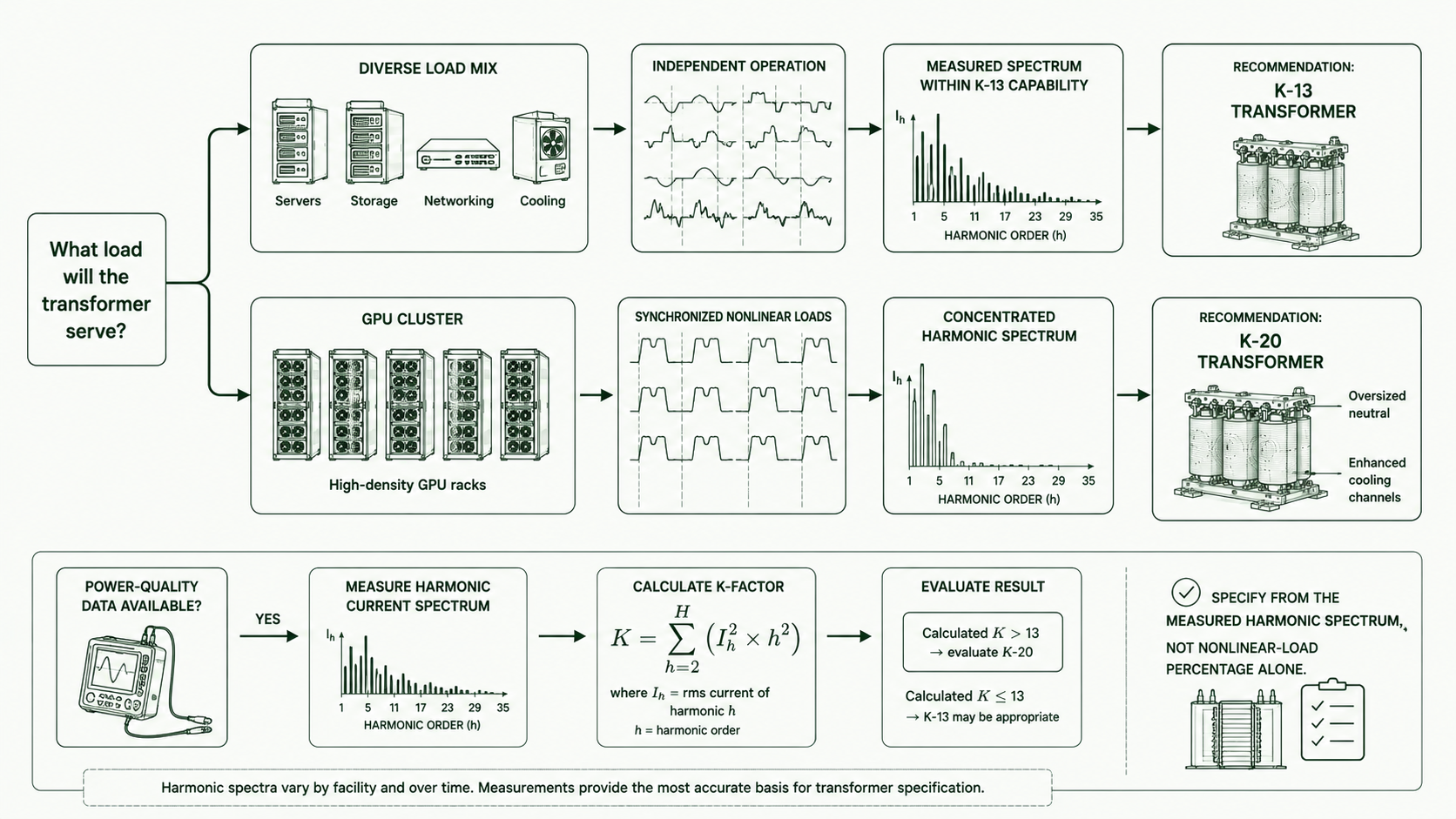
Use workload composition as your guide — remembering that the deciding factor is the harmonic spectrum, not the raw non-linear percentage:
Specify K-20, 200% neutral, delta-wye at every PDU position serving GPU infrastructure. It covers the worst case, and the cost difference versus K-13 is small relative to the risk of premature failure and unplanned downtime.
The older harmonic-mitigation guidance was right — for its era. That data center had moderate non-linear loads, natural diversity across workload types, and intermittent peak demand with daily and weekly recovery cycles. A K-13 transformer could handle it.
The data center of 2026 has AI training clusters drawing 120 kW per rack through nearly 100% non-linear power supplies, running at sustained near-capacity for weeks. The power swings are synchronized, the harmonic content is concentrated, and the transformers see no thermal recovery. The old playbook doesn't apply.
If you're building or retrofitting for AI workloads, start with K-20 rated transformers at every PDU position. It's the simplest, most proven, most cost-effective first line of defense against harmonic-induced transformer damage. And if your situation demands more — HMTs for generator-mode operation, active filters for retrofit constraints — the approaches layer.
Quality Transformer & Electronics (QT&E) manufactures K-20 rated transformers for AI data center PDU applications as a standard product — 75 to 500 kVA, copper windings, 200% neutral, high-temperature insulation, delivered in 4–6 weeks. Get the foundation right first.
Quality Transformer & Electronics — UL 1561 Listed | DOE 2016 Compliant | ISO 9001:2015 | Made in California
What is the difference between a K-rated transformer and a harmonic mitigating transformer? A K-rated transformer tolerates harmonics — it's built with extra thermal capacity, oversized conductors, and an oversized neutral to survive harmonic heating without reducing the harmonics themselves. A harmonic mitigating transformer (HMT) cancels specific harmonics electromagnetically, using zigzag windings to trap triplen harmonics and paired phase-shifted units to cancel the 5th, 7th, 17th, and 19th — reducing the distortion that flows upstream. K-rated is simpler and cheaper and fits most PDU applications; HMTs cost more but are the better choice where upstream voltage THD must stay low, especially on generator power.
Do AI and GPU data centers need K-20 transformers instead of K-13? Usually yes. GPU clusters are homogeneous, synchronized, sustained non-linear loads with no diversity to cancel harmonics — the specific condition K-20 is built for. K-13 remains appropriate for diverse, mixed compute environments. The deciding factor is the harmonic spectrum the transformer actually sees, not whether the equipment is labeled "AI."
Can't I just use an active harmonic filter instead of the right transformer? Active filters are excellent in specific situations — retrofits where the transformer can't be replaced, or facilities with shifting load profiles — but they add active electronics that can fail, require ongoing maintenance, and consume power. For new construction, a correctly specified K-20 transformer is simpler, more reliable, and lower total cost as the primary mitigation, with active filters layered on only if IEEE 519 compliance at the PCC demands it.
How do I calculate the K-factor my data center needs? With power-quality meter data, use K = Σ(Iₕ² × h²), where h is the harmonic order and Iₕ is the per-unit RMS current at that harmonic; if the result exceeds 13, specify K-20 for those positions. Without measurements, use workload composition: diverse mixed loads under ~25 kW/rack are generally fine on K-13, while any GPU cluster or homogeneous synchronized non-linear load calls for K-20.
Why do harmonics damage transformers? Harmonic currents cause additional heating in transformer windings that rises with the square of frequency — the 5th harmonic produces ~25× the eddy-current loss of the fundamental, the 13th ~169×. That extra heat drives up winding hot-spot temperature, and because insulation life roughly halves for every 10 °C of overshoot, an under-specified transformer under sustained AI load can lose the majority of its service life and then fail abruptly rather than gradually.
Does the 800 VDC data center architecture eliminate harmonic concerns? No. NVIDIA's 800 VDC architecture removes the AC/DC supply from inside the rack but converts grid AC to 800 VDC at the facility perimeter using large rectifiers — themselves concentrated non-linear loads. The harmonic problem moves upstream and concentrates rather than disappearing, which keeps harmonic-aware transformer design relevant at the perimeter conversion stage. For most existing halls this is a 2027-and-later, greenfield consideration.


